
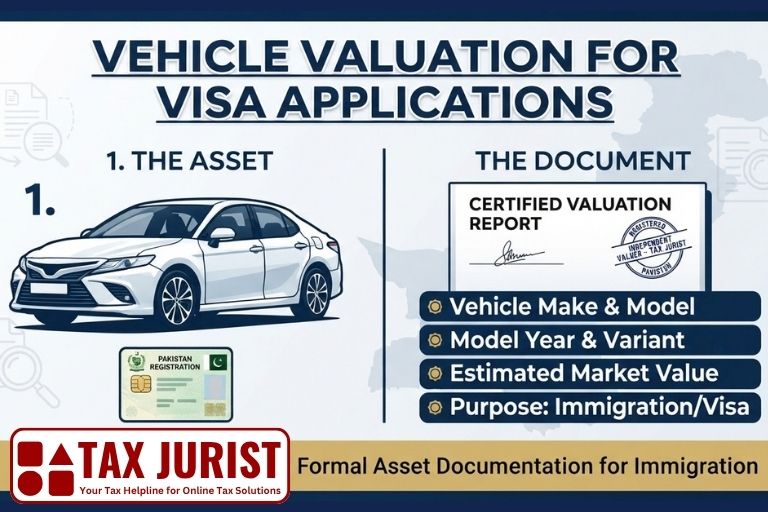
Vehicle Valuation Report Pakistan for Visa and Immigration
When you are preparing a visa or immigration application, even a straightforward asset such as a car can raise an important question: what is the vehicle actually worth today?
A vehicle valuation report provides a structured way to document the estimated value of a particular vehicle in Pakistan. It can be useful when an applicant wants to include a vehicle among their supporting assets or financial documentation for an immigration or visa application.
At Tax Jurist Pakistan, vehicle valuation reports are prepared through a registered independent valuer. The report is based on the particulars of the vehicle and the supporting documents made available for the valuation.
The report is prepared specifically for immigration and visa documentation. It should not be treated as a valuation for lending, mortgage, sale, purchase, financing, insurance, or any other purpose.
Most importantly, a vehicle valuation should be considered alongside the requirements of the relevant immigration authority. A valuation report does not automatically replace bank statements, proof of funds, income evidence, tax records, or any other document specifically requested by a visa authority.
What Is a Vehicle Valuation Report?
A vehicle valuation report is a formal document that identifies a particular vehicle and states its estimated value based on the information and supporting documentation considered by the independent valuer.
Unlike an informal estimate from a friend, dealer, online advertisement, or social-media listing, a valuation report is prepared as a separate professional document.
Depending on the vehicle and available records, the report may include information such as:
- Vehicle make and model
- Model year
- Variant
- Registration number
- Engine capacity
- Chassis number
- Engine number
- Fuel type
- Transmission
- Mileage, where available
- Vehicle condition, where relevant
- Ownership information
- Registration information
- Other characteristics relevant to the valuation
- Estimated value of the vehicle
The purpose is to create a clear record of the particular vehicle being valued and the estimated value assigned to it.
Vehicle Valuation Report for Visa Applications in Pakistan
For many applicants, financial documentation is not limited to money in a bank account.
A person may own:
- A house or other property
- A vehicle
- Savings
- Investments
- A business
- Other assets
Where an applicant needs to document a vehicle as part of an immigration or visa file, a vehicle valuation report can provide a separate record of the vehicle’s estimated value.
The important point is to keep different types of financial evidence separate.
A vehicle valuation tells the reader about the estimated value of a vehicle. It does not, by itself, establish that the applicant has an equivalent amount of cash available in a bank account.
This distinction matters because immigration authorities can impose very specific financial-document requirements.
For example, Canada’s official Express Entry guidance explains that proof of funds must demonstrate that the applicant has sufficient funds and requires specific evidence from financial institutions.
Likewise, the UK’s Immigration Rules contain specific requirements concerning acceptable financial evidence for routes to which the financial requirement applies.
For Australia, the Department of Home Affairs provides a document-checking system identifying financial-capacity evidence for relevant visa applications.
For this reason, applicants should never assume that a vehicle valuation can replace a document specifically requested by the immigration authority.
Why Would Someone Need a Vehicle Valuation for Immigration?
The answer depends on the person’s application and the documents they are preparing.
A vehicle valuation may be useful when an applicant wants to clearly document an asset owned in Pakistan.
For example, an applicant may be preparing a financial file containing evidence of:
- Personal assets
- Family assets
- Business assets
- Property
- Vehicles
- Savings
- Income
- Tax records
A separate vehicle valuation can make the vehicle component of that documentation easier to understand.
It answers a relatively simple question:
What is the estimated value of this particular vehicle?
The answer can then be considered together with the vehicle’s registration and ownership documents and the other evidence required for the particular visa application.
Vehicle Valuation Is Not the Same as Proof of Funds
This is one of the most important points for applicants to understand.
A vehicle is an asset. It is not the same thing as readily available cash.
For example, if a vehicle is valued at PKR 5 million, that does not automatically mean that the applicant has PKR 5 million in accessible funds.
Canadian immigration guidance provides a useful illustration of this distinction. For Express Entry programs requiring proof of funds, IRCC specifies financial evidence such as official bank letters and account information and says the funds must be available to the applicant.
Similarly, UK immigration rules specify forms of financial evidence that can be accepted for applicable routes.
Therefore, applicants should treat a vehicle valuation as asset documentation, not automatically as proof of liquid funds.
Can a Vehicle Valuation Replace Bank Statements?
No.
If the relevant immigration authority asks for:
- Bank statements
- Bank letters
- Proof of funds
- Salary evidence
- Employment records
- Tax returns
- Business financial records
- Other specified financial documents
those requirements should be addressed separately.
A vehicle valuation can document the estimated value of the vehicle, but it should not be presented as a substitute for evidence that the immigration authority expressly requires.
Canada’s official supporting-document guidance, for example, identifies applications that may require proof of funds or income and directs applicants to the requirements applicable to their particular program.
What Information Is Normally Considered for Vehicle Valuation?
A vehicle is more than its make and model. Two vehicles of the same model and year can have different values because their condition, mileage, specifications and history may differ.
The independent valuer may therefore consider information such as:
Vehicle Make and Model
The exact make, model and variant help identify the vehicle being valued.
Model Year
Age is an important consideration in determining the current estimated value of a vehicle.
Engine Capacity
Engine capacity can be relevant to the vehicle’s specifications and market characteristics.
Registration Details
Registration information helps connect the valuation to the specific vehicle.
Chassis and Engine Numbers
These identifiers can help distinguish the vehicle from another vehicle of the same make and model.
Mileage
Where reliable mileage information is available, it may be relevant to the assessment.
Condition
The condition of the vehicle can affect its estimated value.
Market Considerations
The valuer may consider relevant market information and characteristics affecting the estimated value.
The precise methodology and information considered can vary according to the vehicle and circumstances.
Documents for Vehicle Valuation in Pakistan
The exact documentation depends on the vehicle and the records available.
Applicants may be asked to provide relevant documents such as:
- Vehicle registration certificate
- Registration book or card
- Owner’s CNIC
- Vehicle registration information
- Purchase documents, where available
- Sales invoice, where available
- Import documents, where applicable
- Other documents that help establish the identity and ownership of the vehicle
The official Punjab Excise & Taxation Department publishes vehicle-registration requirements, including documentation for locally manufactured and imported vehicles.
For locally manufactured vehicles, the department’s published information refers to documents including the owner’s CNIC, original sales certificate and original sales invoice in relevant registration circumstances.
For imported vehicles, the official requirements can include documents such as import permission, goods declaration, invoice and bill of lading.
Applicants should provide documents that actually relate to their vehicle rather than collecting unnecessary paperwork.
Vehicle Registration Records in Pakistan
Vehicle registration records are particularly useful because they help establish the identity of the vehicle.
In Punjab, the Excise, Taxation & Narcotics Control Department provides government services relating to vehicle registration, ownership transfer, vehicle verification and motor vehicle taxation.
Its official website provides online services including verification of registered vehicles, motor vehicle tax calculations and vehicle registration/post-registration services.
The department also provides official information about vehicle registration and post-registration transactions.
Applicants with vehicles registered in Punjab can therefore use the official Excise resources when checking their registration-related information.
Other provinces and territories have their own vehicle-registration systems and procedures.
For example, the Islamabad Capital Territory Administration publishes official information about vehicle registration, including documentation for imported vehicles and relevant registration requirements.
Vehicle Valuation and Excise & Taxation Records
A common source of confusion is the difference between a vehicle’s tax-related value and a professional valuation.
Government departments may use vehicle values for purposes such as:
- Registration
- Taxation
- Transfer
- Withholding tax
- Other statutory charges
Punjab’s official motor vehicle tax information, for example, contains different rates and calculations involving vehicle value, engine capacity, registration and other factors.
Those figures should not automatically be treated as the current estimated market value of a particular vehicle for immigration documentation.
A vehicle valuation report serves a different documentary purpose.
Vehicle Valuation vs. FBR Customs Valuation
Another distinction worth understanding is the difference between a vehicle valuation prepared for immigration documentation and customs valuation.
The Federal Board of Revenue’s customs valuation framework deals with the valuation of imported goods for customs purposes.
FBR publishes official customs valuation information and valuation rulings through its official website.
A customs valuation ruling therefore should not automatically be treated as the same thing as a current independent valuation of a privately owned vehicle for an immigration file.
The two documents can serve entirely different purposes.
Applicants should be careful not to mix:
- Customs value
- Tax value
- Registration value
- Original purchase price
- Insurance value
- Current estimated value
- Immigration asset documentation
These figures may be different because they are created for different reasons.
How a Vehicle Valuation Report Is Prepared
A straightforward valuation process generally begins with accurate information about the vehicle.
Step 1: Vehicle Details Are Provided
The applicant provides the available details of the vehicle.
This can include the registration number, make, model, year, engine capacity and other identifying information.
Step 2: Supporting Documents Are Submitted
Relevant registration, ownership and other documents are provided for review.
Step 3: Information Is Checked
The information is reviewed so that the valuation relates to the correct vehicle.
Step 4: Independent Valuation Is Conducted
The registered independent valuer assesses the relevant information and determines the estimated value.
Step 5: Report Is Prepared
The findings are presented in a formal vehicle valuation report.
Step 6: Report Is Used as Supporting Immigration Documentation
The applicant can consider the report alongside the other documents required for the particular immigration or visa application.
The report does not determine what the immigration authority will accept. That decision belongs to the relevant authority under the rules applicable to the particular application.
Registered Independent Valuer
The person preparing a valuation matters.
At Tax Jurist Pakistan, vehicle valuation reports are prepared through a registered independent valuer.
This provides an important distinction from an informal valuation based solely on:
- A vehicle dealer’s verbal estimate
- A social-media advertisement
- A classified listing
- An applicant’s personal estimate
- A price found through a general internet search
Online advertisements can sometimes help demonstrate what vehicles are being offered for, but the advertised price of another vehicle is not necessarily the value of the applicant’s specific vehicle.
A formal valuation focuses on the identified vehicle and the information relevant to that vehicle.
What Should a Good Vehicle Valuation Report Show?
A clear report should allow the reader to understand what has been valued.
Depending on the report format, this may include:
Vehicle Identification
The report should clearly identify the vehicle being valued.
Ownership Information
Relevant ownership information should correspond with the supporting documents.
Valuation Date
The date of the assessment can help establish when the stated value applies.
Estimated Value
The assessed value should be clearly stated rather than buried in the document.
Valuer Information
The report should identify the independent valuer responsible for the valuation.
Supporting Information
The relevant information considered in reaching the valuation should be appropriately recorded.
The goal is not to make the report unnecessarily complicated. The goal is to make it understandable.
Vehicle Valuation for Applicants Living Outside Pakistan
Many Pakistani applicants preparing immigration applications may be living outside Pakistan while still owning assets in Pakistan.
A vehicle can remain registered in Pakistan even when its owner is temporarily or permanently abroad.
In such cases, an applicant may need to organize documentation remotely.
The process can involve providing:
- Vehicle information
- Registration documents
- Ownership information
- Identity documentation where required
- Other relevant supporting documents
The information can then be reviewed for preparation of the valuation through the registered independent valuer.
The availability of remote documentation can be particularly useful for applicants who cannot conveniently visit Pakistan simply to arrange an asset document.
Vehicle Valuation for Overseas Pakistani Applicants
A Pakistani living abroad may have a vehicle registered in Pakistan and may wish to document that asset as part of an immigration or visa file.
The same basic principles apply:
- Identify the vehicle accurately.
- Establish the ownership information.
- Provide relevant registration documentation.
- Provide supporting documents where available.
- Have the vehicle independently valued.
- Keep the valuation separate from proof-of-funds documentation.
This can help maintain a clear paper trail when documents from Pakistan form part of a larger immigration application.
Vehicle Valuation for Different Immigration and Visa Applications
There is no universal rule that every visa applicant needs a vehicle valuation.
Its usefulness depends on the specific application.
Study Visa
A student or sponsor may have vehicles and other assets as part of their wider financial circumstances.
Whether those assets should be documented depends on the particular visa requirements and the circumstances of the application.
Australia’s Department of Home Affairs, for example, identifies financial-capacity evidence among the documents that may be required for relevant student visa applications.
Permanent Residence
Some permanent-residence programs have detailed financial requirements.
Applicants should check whether the program requires proof of funds and, if so, what forms of evidence are accepted.
Canada’s official immigration guidance provides program-specific information concerning proof of funds.
Family Immigration
Family immigration applications can require evidence relating to the sponsor, applicant, income or financial circumstances.
A vehicle valuation may be useful as supplementary asset documentation where appropriate, but the applicant should follow the specific requirements for the relevant route.
Visit Visa
A vehicle may form part of a person’s overall asset position, but applicants should not assume that a valuation is mandatory for every visit visa.
Work Visa
Requirements differ significantly between work-visa categories. The applicant should check the official immigration requirements for the destination country and specific route.
UK Immigration and Vehicle Assets
UK visa applicants should rely on the current UK Government immigration rules and official visa guidance applicable to their route.
The UK Immigration Rules contain specific financial requirements for certain immigration categories, including rules about acceptable financial evidence.
A vehicle valuation may provide information about an asset, but applicants should not assume that the value of that asset satisfies a financial requirement unless the applicable UK rules specifically allow it.
The safest approach is to identify the precise requirement first and then decide whether a vehicle valuation is relevant supporting evidence.
Canada Immigration and Vehicle Assets
Canadian immigration programs can distinguish carefully between assets and funds that are actually available.
For example, IRCC’s Express Entry proof-of-funds guidance states that applicants required to provide proof of funds must demonstrate that they have the required money and provide specific financial evidence.
IRCC also provides broader supporting-document information for different immigration applications.
Therefore, a vehicle valuation should not be presented as though it were equivalent to the bank documentation required under a particular Canadian program.
Where the applicant wishes to document a vehicle as an asset, the valuation can be kept as a separate supporting document.
Australia Immigration and Vehicle Assets
Australian visa requirements vary according to the visa category.
The Australian Department of Home Affairs provides a Document Checklist Tool to help applicants identify documents relevant to their application.
Where a particular application requires evidence of financial capacity, applicants should follow the official requirements rather than relying on a general assumption that vehicle ownership is sufficient.
A vehicle valuation may be supplementary documentation where relevant to the applicant’s circumstances.
What About Vehicles Registered in Punjab?
For vehicles registered in Punjab, the official Punjab Excise & Taxation Department provides a range of vehicle-related services.
The department’s website includes:
- Online vehicle verification
- Motor vehicle tax calculator
- Vehicle registration information
- Post-registration transaction information
- Online vehicle ownership transfer services
- Vehicle taxation information
These services are available through the government’s official Excise & Taxation platform.
The department’s registration guidance also explains documentation requirements for locally manufactured and imported vehicles.
This official documentation can be useful when gathering the records needed to identify a vehicle before valuation.
What About Vehicles Registered in Islamabad?
Vehicle owners in Islamabad can refer to the official ICT Administration resources for vehicle-registration information.
The ICT Administration publishes requirements concerning registration, including documentation for imported vehicles and applicable fees and taxes.
Applicants should use the government authority relevant to their vehicle’s registration rather than relying on an unofficial website for registration requirements.
What If the Vehicle Is Imported?
Imported vehicles may have a more extensive documentary history.
Depending on the circumstances, records may include:
- Import permission
- Goods declaration
- Invoice
- Bill of lading
- Registration documentation
- Customs-related records
Punjab’s official vehicle-registration guidance specifically lists several of these documents for imported-vehicle registration.
The availability of these records can help establish the vehicle’s identity and history.
However, an import document should not automatically be interpreted as the vehicle’s current market value.
What If the Vehicle Was Purchased Many Years Ago?
That is common.
A vehicle’s original purchase price may have little relationship to its current estimated value.
For example, a vehicle purchased several years ago may have experienced:
- Depreciation
- Changes in market demand
- Changes in model availability
- Changes in replacement costs
- Mileage accumulation
- Changes in physical condition
Consequently, a valuation report provides a more current assessment than simply reproducing an old purchase invoice.
The purchase invoice can still be useful as supporting ownership or transaction documentation where relevant.
What If the Vehicle Is Owned Jointly?
Where more than one person has an ownership interest, the ownership documentation should be reviewed carefully.
The applicant should ensure that the valuation report and supporting documents do not create an inaccurate impression about who owns the vehicle.
If an immigration application requires disclosure of ownership interests, the applicant should follow the applicable rules and provide the relevant documentation.
What If the Vehicle Is Financed?
A financed vehicle can involve additional ownership or liability considerations.
Applicants should not assume that the gross estimated value of a vehicle is automatically equivalent to the applicant’s net financial interest in it.
If financing, leasing, hire purchase or another encumbrance affects the applicant’s interest in the vehicle, the relevant immigration requirements should be considered carefully.
The important principle is simple:
The estimated value of the vehicle and the applicant’s actual financial position are not necessarily the same thing.
Common Mistakes When Using Vehicle Valuation Reports for Immigration
Mistake 1: Treating the Report as Proof of Cash
A vehicle valuation does not turn a vehicle into cash.
Mistake 2: Using an Unverified Online Price
A listing for a similar vehicle is not necessarily a valuation of the applicant’s vehicle.
Mistake 3: Providing Incorrect Vehicle Numbers
Registration, chassis and engine numbers should be checked carefully.
Mistake 4: Confusing Tax Value With Current Estimated Value
Government tax calculations can have a different purpose from an independent valuation.
Mistake 5: Assuming Every Visa Authority Accepts the Same Documents
Immigration rules vary between countries, visa categories and individual circumstances.
Mistake 6: Ignoring the Official Document Checklist
Applicants should always check the current official requirements before submitting their application.
Vehicle Valuation Report Checklist
Before arranging a valuation, it can be helpful to gather the following information.
Vehicle Details
- Make
- Model
- Variant
- Model year
- Engine capacity
- Registration number
- Chassis number
- Engine number
- Mileage, where available
Ownership and Registration
- Registration certificate/card
- Registration book/file, where applicable
- CNIC
- Ownership information
- Purchase documents, where available
Imported Vehicle Documents
Where applicable:
- Import permission
- Goods declaration
- Invoice
- Bill of lading
- Other relevant customs or registration records
Immigration File
- Correct visa category identified
- Official immigration requirements checked
- Required proof of funds provided separately
- Required bank documents provided separately
- Translation requirements checked
- Copies are clear and readable
Why Clear Asset Documentation Matters
Immigration files can contain dozens of documents.
A reviewing officer should not have to guess what a particular document is intended to establish.
If a vehicle is included as an asset, a clear documentation chain can look like this:
Vehicle registration → Ownership evidence → Vehicle identification → Independent valuation → Estimated vehicle value
Each document has its own role.
This is much clearer than simply writing a vehicle value in a financial statement without supporting documentation.
Vehicle Valuation Report Pakistan: What It Can and Cannot Do
A useful way to understand a vehicle valuation is to separate its purpose from other financial documents.
| Document | Main purpose |
|---|---|
| Vehicle registration | Identifies the registered vehicle and registration information |
| Ownership document | Supports ownership information |
| Purchase invoice | Records a historical purchase |
| Vehicle valuation report | Records an independent estimated value |
| Bank statement | Shows banking activity and balances |
| Bank letter | Provides financial-account information |
| Salary certificate | Supports employment income |
| Tax return | Provides tax and income information |
| Property valuation | Provides an estimated value for identified property |
One document does not automatically replace another.
Official Government Sources for Applicants
Because immigration and vehicle rules can change, applicants should check official sources before finalizing their documents.
Pakistan Vehicle Documentation
The Punjab Excise, Taxation & Narcotics Control Department provides official information and online services relating to motor vehicles, registration, verification, taxation and ownership transactions.
Applicants can also consult the department’s motor vehicle registration and post-registration information for current documentation requirements.
The government’s motor vehicle tax information provides information about applicable vehicle taxes and fees in Punjab.
For Islamabad-registered vehicles, the ICT Administration vehicle-registration service provides government information about registration requirements and related matters.
For customs-related information, applicants can consult the Federal Board of Revenue and its official customs valuation resources.
Canada
Applicants should consult Immigration, Refugees and Citizenship Canada for current immigration requirements.
For Express Entry, the official proof-of-funds requirements explain what financial evidence is required for applicants who need to demonstrate settlement funds.
Applicants can also review the government’s supporting-document information for broader application-document requirements.
United Kingdom
Applicants should consult the UK Government visas and immigration service for current requirements.
The UK Immigration Rules and applicable financial provisions should be checked for the particular immigration route. The government’s Appendix Finance sets out financial requirements for specified routes.
Australia
Applicants should use the official Australian Department of Home Affairs website for current visa requirements.
The department’s Document Checklist Tool can help applicants identify evidence relevant to their visa application.
Frequently Asked Questions About Vehicle Valuation Reports in Pakistan
What is a vehicle valuation report for immigration?
It is a formal report stating the estimated value of an identified vehicle. It can be used as supporting asset documentation where relevant to an immigration or visa application.
Who prepares the vehicle valuation?
The valuation is carried out through a registered independent valuer.
Is a vehicle valuation required for every visa?
No. The requirement depends on the visa category, destination country and applicant’s circumstances.
Can I use a vehicle valuation as proof of funds?
Not automatically. A vehicle valuation documents an asset; proof-of-funds requirements may require evidence of money that is actually available to the applicant.
Can a vehicle valuation replace bank statements?
No. If bank statements or bank letters are specifically required, they should be provided separately.
Can the report be used for a Canadian immigration application?
It may be used as supporting asset documentation where relevant, but Canadian immigration programs have their own documentary requirements. Applicants should check the official IRCC requirements applicable to their program.
Can it be used for a UK visa?
It may be supplementary documentation where relevant, but applicants should follow the financial and documentary requirements applicable to their specific UK immigration route.
Can it be used for an Australian visa?
Potentially as supporting documentation where relevant, but the applicant should follow the document requirements for the specific Australian visa.
Does the valuation equal the vehicle’s sale price?
Not necessarily. A valuation is an estimated value determined for the stated purpose and based on the information considered by the valuer. A future transaction price can be different.
Is the vehicle’s original purchase price its current value?
Not necessarily. The vehicle’s value can change over time because of age, mileage, condition, market conditions and other factors.
Can an online advertisement be used instead of a valuation report?
An online advertisement is not necessarily a professional valuation of the applicant’s particular vehicle.
Is FBR customs value the same as vehicle valuation?
No. Customs valuation serves customs-related purposes and should not automatically be treated as the current estimated value of a privately owned vehicle for immigration documentation.
Can I obtain a valuation for a vehicle registered in Punjab?
Yes, vehicle registration documents and information can be used to identify the vehicle for valuation. Punjab’s Excise & Taxation Department publishes official information concerning vehicle registration and related records.
What if I live outside Pakistan?
Applicants living abroad can provide the available vehicle information and supporting documentation for the valuation process, subject to the documents required for the particular vehicle.
What documents should I keep ready?
Generally, the vehicle registration document, ownership information, CNIC and other relevant vehicle records should be kept available. Imported vehicles may require additional documentation.
Vehicle Valuation Report Pakistan for Visa and Immigration — Tax Jurist Pakistan
At Tax Jurist Pakistan, we understand that immigration documentation often involves putting together information from different sources and presenting it in a clear, organized way.
A vehicle can be an important personal or family asset. When an applicant needs to document the estimated value of that vehicle, a professionally prepared valuation report can provide a clear record of the asset.
Our vehicle valuation reports are prepared through a registered independent valuer and are intended specifically for immigration and visa documentation.
The process focuses on the particular vehicle, its identifying information, relevant supporting documents and the independent valuation.
The report should then be considered alongside the applicant’s other immigration documents, including any bank statements, proof of funds, income evidence, tax documents, property records or other documents specifically required by the relevant immigration authority.
A Simple Principle for Immigration Documentation
The purpose of a vehicle valuation report is not to make an immigration application more complicated.
It is to answer one specific question clearly:
What is the estimated value of this identified vehicle?
Once that information is properly documented, the applicant can place it alongside the other evidence required for the application.
For current visa requirements, applicants should always consult the official immigration authority for their destination country and the particular visa or immigration route they are applying under.