
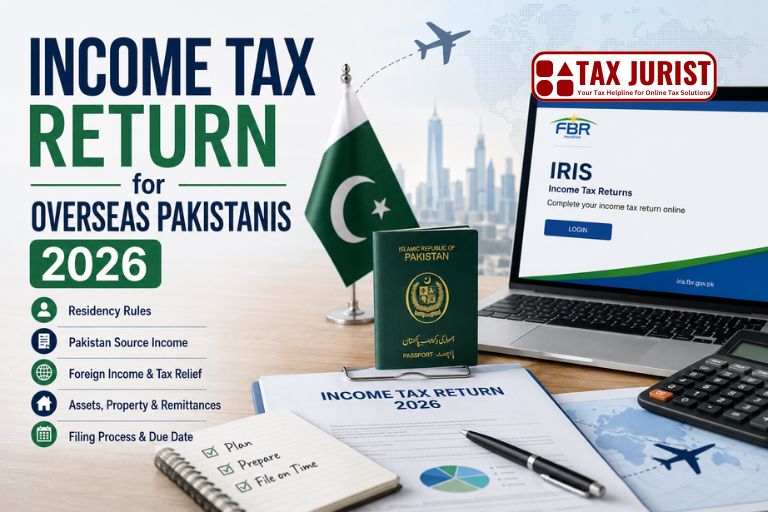
For an overseas Pakistani, filing an income tax return in Pakistan in 2026 is not simply a question of whether money is earned abroad. The first and most important question is whether you are a resident or non-resident individual for Pakistani tax purposes, followed by an assessment of your Pakistan-source income, foreign income, assets, remittances, property transactions and other relevant financial activities.
Pakistan’s tax system distinguishes between resident and non-resident persons. Under the Income Tax Ordinance, 2001, an individual generally becomes a resident individual where the person is present in Pakistan for 183 days or more during the tax year, subject to the other statutory rules. A person who does not qualify as resident is generally treated as non-resident.
For Tax Year 2026, taxpayers should also be aware that the Federal Board of Revenue (FBR) has issued the relevant electronic return framework and continues to require online filing through the IRIS system. FBR’s current due-date information states that individuals and associations of persons generally file their income tax returns by 30 September.
This guide explains the practical issues an overseas Pakistani should consider before filing an income tax return for 2026.
What Is Tax Year 2026 in Pakistan?
A common source of confusion for overseas Pakistanis is the meaning of “Tax Year 2026.”
Pakistan’s tax year generally ends on 30 June. Therefore, Tax Year 2026 broadly relates to the financial period ending 30 June 2026, rather than income earned during the calendar year January to December 2026.
This distinction matters when preparing:
- salary and employment income;
- rental income;
- business income;
- investment income;
- capital gains;
- bank profit;
- dividends;
- property transactions;
- withholding taxes;
- foreign income;
- assets and liabilities; and
- remittances.
The FBR has issued the Tax Year 2026 return framework, including electronic return arrangements for individuals.
When Is the Tax Return for Tax Year 2026 Due?
For an individual, the general statutory due date is 30 September following the end of the tax year. FBR’s published income tax due-date information identifies 30 September as the normal deadline for individuals and AOPs.
However, taxpayers should not assume that a previous year’s extension will automatically apply to Tax Year 2026. Any extension should be confirmed from an official FBR notification.
Do Overseas Pakistanis Have to File an Income Tax Return in Pakistan?
Being an Overseas Pakistani Does Not Automatically Mean “No Tax Return”
There is no blanket rule that every Pakistani living abroad is exempt from filing a Pakistani income tax return.
Similarly, living outside Pakistan does not automatically make every person a Pakistani tax non-resident for every tax year.
The correct approach is to examine the individual’s residential status and filing obligations under Pakistani tax law.
An overseas Pakistani may have Pakistani tax obligations because of:
- rental income from property in Pakistan;
- a business carried on in Pakistan;
- income from Pakistan-based investments;
- capital gains arising from taxable transactions;
- Pakistan-source employment or professional income;
- other Pakistan-source income;
- ownership and financial transactions requiring tax documentation; or
- other circumstances that make filing legally necessary or practically important.
When Can Filing Still Be Useful Even If You Are Non-Resident?
A non-resident overseas Pakistani may have good reasons to maintain tax compliance even when the person’s principal income is earned abroad.
For example, filing may help create a documented tax record concerning:
- Pakistan-based property;
- rental income;
- investments;
- capital gains;
- withholding taxes;
- remittances;
- wealth position; and
- transactions requiring evidence of tax compliance.
- The important point is that non-resident status and “no filing requirement” are not necessarily the same thing.
How Is an Overseas Pakistani Classified as Resident or Non-Resident?
The 183-Day Rule
The most familiar test concerns physical presence in Pakistan.
Under section 82 of the Income Tax Ordinance, an individual is a resident individual where the individual is present in Pakistan for a period or periods amounting in aggregate to 183 days or more during the tax year.
Consequently, an overseas Pakistani should calculate actual days spent in Pakistan during the relevant tax year rather than relying solely on:
- Pakistani nationality;
- CNIC;
- NICOP;
- POC;
- foreign residence;
- foreign passport;
- overseas employment; or
- a permanent home outside Pakistan.
Why Physical Presence Matters
Consider an overseas Pakistani who normally works in Saudi Arabia but spends substantial periods in Pakistan during the tax year.
The person’s foreign employment does not, by itself, answer the Pakistani tax-residency question.
The number of days spent in Pakistan and the statutory residence rules must be considered.
Does NICOP Automatically Make Someone Non-Resident?
No.
NICOP is an important identity document for overseas Pakistanis, but possession of NICOP does not by itself determine income-tax residence.
The tax analysis should instead be based on the applicable provisions of the Income Tax Ordinance and the facts of the relevant tax year.
This distinction is particularly important because FBR’s overseas-Pakistani guidance separately refers to persons holding NICOP or POC and also requires consideration of whether they are actually non-resident.
What Income of an Overseas Pakistani Can Be Taxable in Pakistan?
Pakistan-Source Income
For a non-resident person, the central issue is often Pakistan-source income.
Examples can include income connected with:
- immovable property located in Pakistan;
- business activities carried on in Pakistan;
- services performed in Pakistan;
- certain investments;
- Pakistan-based assets;
- capital gains from taxable Pakistan transactions; and
- other income falling within Pakistan’s source rules.
The fact that an overseas Pakistani receives money in a foreign bank account does not automatically determine whether Pakistan has taxing rights.
Likewise, the fact that money enters Pakistan does not automatically mean that the entire amount is taxable income.
Each receipt should be examined according to its legal character and source.
Is Salary Earned Abroad Taxable in Pakistan?
If the Overseas Pakistani Is Non-Resident
A genuinely non-resident individual generally needs to distinguish between foreign-source income and Pakistan-source income.
If a person works abroad, performs employment services abroad and is non-resident in Pakistan, the foreign salary will generally require a different analysis from salary or other income arising from Pakistan.
This is one reason why incorrectly selecting “resident” or “non-resident” status on a return can have significant consequences.
If the Person Is Resident in Pakistan
The position can change substantially if the individual qualifies as resident.
Pakistan’s tax law contains specific provisions dealing with foreign-source income of residents, including foreign-source salary and foreign tax credits.
For example, section 102 provides an exemption for certain foreign-source salary received by a resident individual where foreign income tax has been paid in respect of that salary.
Foreign tax relief therefore should not be confused with a general rule that all foreign income is automatically tax-free.
Foreign Income Tax and Double Taxation
Can Foreign Tax Paid Abroad Be Considered in Pakistan?
Pakistan’s income-tax framework contains provisions dealing with relief from international double taxation.
Section 103 addresses foreign tax credits, while the relevant rules prescribe what can qualify as foreign income tax. FBR’s current material explains that sections 102 and 103 provide relief to resident persons from international double taxation.
This can become particularly relevant where an overseas Pakistani:
- is treated as resident in Pakistan for the relevant tax year;
- earns income outside Pakistan;
- pays tax on that income in another jurisdiction; and
- is required to consider Pakistani taxation of that income.
The availability and amount of relief depend on the applicable legal provisions and facts.
Do Not Assume a Foreign Tax Payment Automatically Eliminates Pakistani Tax
A foreign tax payment does not mean that the taxpayer can simply omit the income from the Pakistani return.
The correct approach is to:
- identify the income;
- determine its source;
- determine residential status;
- identify the applicable Pakistani provision;
- determine whether foreign tax was actually paid;
- consider the relevant tax treaty, where applicable; and
- calculate any available exemption or foreign tax credit correctly.
What Should Overseas Pakistanis Declare in the Wealth Statement?
The Wealth Statement Is Often as Important as the Income Tax Return
For taxpayers required to submit a wealth statement, filing an income tax return is not limited to reporting annual income.
FBR explains that the online filing process requires completion of the Return of Income and Wealth Statement, and that the wealth statement must reconcile with the taxpayer’s income and expenses.
This is particularly important for overseas Pakistanis because their financial affairs can involve several countries.
A wealth statement may involve consideration of:
- Pakistani bank accounts;
- foreign bank accounts where disclosure is legally required;
- houses and apartments;
- agricultural land;
- commercial property;
- vehicles;
- investments;
- business interests;
- loans and liabilities;
- cash and other assets; and
- changes in wealth during the year.
What Is Wealth Reconciliation?
In simple terms, the movement in your wealth should make financial sense in relation to your declared income, expenses and other relevant sources of funds.
FBR explains that the wealth statement will not successfully submit unless the change in wealth reconciles with the difference between income and expenses.
This is why an overseas Pakistani should not treat the wealth statement as a formality.
How Should Overseas Remittances Be Treated?
A Remittance Is Not Automatically the Same Thing as Taxable Income
One of the most common misunderstandings among overseas Pakistanis is:
“I sent money from abroad to Pakistan, so that amount must either be taxable or must be entered as salary.”
That conclusion is not necessarily correct.
A remittance is fundamentally a movement of funds. Its tax treatment depends on the underlying source and the applicable law.
For example, money transferred to Pakistan may represent:
- foreign employment savings;
- family support;
- funds for purchasing property;
- investment capital;
- proceeds from the sale of an asset;
- business funds;
- a loan;
- a gift; or
- another source.
The taxpayer should be able to explain the nature and source of significant funds.
Why Documentation Matters
An overseas Pakistani should retain evidence such as:
- bank statements;
- remittance receipts;
- salary slips;
- foreign tax documents;
- employment records;
- property sale documents;
- investment statements;
- loan agreements; and
- other source-of-funds documentation.
The objective is not to create unnecessary paperwork. It is to ensure that the taxpayer can substantiate the financial story shown in the return and wealth statement.
Property Owned by Overseas Pakistanis in Pakistan
Is Rental Income From Pakistani Property Taxable?
Potentially, yes.
An overseas Pakistani who owns a house, apartment, commercial building, shop or other immovable property in Pakistan should separately consider any rental income arising from that property.
The analysis may involve:
- gross rent;
- allowable deductions;
- withholding taxes;
- ownership;
- co-ownership;
- expenses;
- tenancy agreements; and
- the taxpayer’s residential status.
The fact that rent is collected through a Pakistani bank account is not the only factor. The source and character of the income are important.
What Happens When an Overseas Pakistani Buys or Sells Property?
Property transactions can create tax consequences beyond the annual income tax return.
FBR has specific rules concerning advance income tax collected in connection with purchase and sale of immovable property under sections 236K and 236C.
Importantly, FBR currently provides special guidance for certain overseas Pakistanis holding NICOP or POC who are also non-resident.
FBR states that eligible overseas Pakistanis can obtain the filer rate for advance tax under sections 236C and 236K even where they have not filed a return, subject to the prescribed conditions and verification procedure.
Does This Mean Every Overseas Pakistani Gets Filer Rates Automatically?
No.
FBR’s published procedure requires, among other things:
- NICOP or POC;
- non-resident status;
- supporting documentation; and
- approval through the prescribed process.
The relevant authority, registrar or housing society initiates the applicable process, and FBR’s system allows the documentation to be reviewed by the concerned Commissioner.
Therefore, an overseas Pakistani should not confuse being an overseas Pakistani with automatically qualifying for every tax benefit available to non-residents.
Overseas Pakistanis and Active Taxpayer Status
What Is the Difference Between Filing and Being on the ATL?
Filing an income tax return and appearing on the Active Taxpayer List (ATL) are related but distinct concepts.
An individual may need to consider the consequences of filing on time, late filing and ATL status depending on the transaction involved.
This can be especially important where an overseas Pakistani:
- purchases property;
- sells property;
- invests in Pakistan;
- receives certain taxable payments; or
- needs to demonstrate tax compliance.
FBR maintains official information concerning income tax filing and taxpayer status through its online systems.
How to File an Income Tax Return for Overseas Pakistanis in 2026
Step 1: Determine Your Tax Residency
Before opening the return form, determine whether you were:
- resident in Pakistan; or
- non-resident in Pakistan
for Tax Year 2026.
Start with the statutory residence tests and your actual physical presence in Pakistan.
Do not select non-resident status merely because you work overseas.
Step 2: Confirm Your FBR Registration
If you are already registered, verify that your IRIS credentials are working.
For individuals, FBR explains that e-enrollment provides access to the IRIS system and that the individual’s CNIC is used as the NTN or registration number.
If you have forgotten your password, FBR provides a password-reset mechanism through IRIS.
Step 3: Gather Your Financial Information
Before starting the return, collect:
Pakistani Information
- Pakistan-source salary;
- rental income;
- business income;
- bank profit;
- dividends;
- property transactions;
- capital gains information;
- withholding tax certificates;
- Pakistani bank statements; and
- other relevant income records.
Foreign Information
Where relevant, collect:
- foreign salary records;
- foreign bank statements;
- investment statements;
- foreign tax certificates;
- foreign property records;
- foreign business information; and
- evidence of foreign taxes paid.
Wealth Information
Also prepare details concerning:
- immovable property;
- vehicles;
- bank balances;
- investments;
- business assets;
- loans;
- liabilities; and
- other relevant assets.
Step 4: Complete the Income Tax Return
FBR’s official filing guidance states that income tax returns are filed online through IRIS. A first-time filer must complete registration before filing.
The return should accurately reflect the taxpayer’s actual circumstances.
Do not enter figures merely because they “look reasonable.”
Tax returns should be based on supporting records.
Step 5: Complete the Wealth Statement
The wealth statement should correspond with the taxpayer’s financial position.
For overseas Pakistanis, special attention should be given to:
- opening wealth;
- closing wealth;
- Pakistani assets;
- relevant foreign assets;
- liabilities;
- foreign remittances;
- personal expenses; and
- changes in wealth.
A mismatch between the return and wealth statement can create unnecessary complications.
Step 6: Reconcile the Wealth Statement
FBR specifically states that the wealth statement must reconcile the movement in wealth with income and expenses before successful submission.
If the figures do not reconcile, investigate the reason rather than simply manipulating a figure to force the software to accept the return.
Common causes include:
- omitted bank balances;
- forgotten assets;
- incorrectly reported opening wealth;
- undocumented transfers;
- incorrectly classified remittances;
- omitted expenses;
- property purchases;
- property sales;
- loans;
- gifts; or
- incorrect exchange-rate treatment.
Step 7: Submit the Return Through IRIS
The return is submitted electronically through IRIS.
FBR explains that successful submission of the Return of Income and Wealth Statement is confirmed when the relevant forms move from the Draft folder to Completed Task.
Do not assume that merely completing the online form means the return has been filed.
Common Mistakes Made by Overseas Pakistanis
Mistake 1: Assuming Overseas Status Automatically Means Non-Resident
Being employed abroad is not, by itself, a complete test.
Always establish residential status under Pakistani law.
Mistake 2: Treating Every Remittance as Taxable Income
A remittance and income are not necessarily the same thing.
The source and nature of the funds should be established.
Mistake 3: Ignoring Pakistani Rental Income
Owning property in Pakistan does not disappear from the tax analysis simply because the owner lives overseas.
Rental income should be considered separately.
Mistake 4: Reporting Foreign Salary Without Considering Residency
Foreign salary needs to be considered alongside residential status and the specific provisions applicable to foreign-source income.
Mistake 5: Forgetting the Wealth Statement
A taxpayer may focus entirely on income while overlooking the assets-and-liabilities side of the return.
This is particularly risky for people who have accumulated wealth in both Pakistan and another country.
Mistake 6: Assuming NICOP Is Proof of Non-Residency
NICOP is not a substitute for the statutory tax-residence test.
FBR’s own overseas-Pakistani guidance distinguishes between holding NICOP/POC and actually being non-resident.
Mistake 7: Waiting Until the Last Day
International taxpayers often need additional time to collect:
- foreign bank records;
- salary certificates;
- tax certificates;
- property documents;
- remittance evidence; and
- exchange-rate information.
Starting early reduces the risk of an incomplete or inconsistent return.
What Documents Should an Overseas Pakistani Keep?
Core Tax Documents
A practical record-keeping file may include:
- CNIC/NICOP/POC details;
- passport and travel history;
- foreign employment documents;
- salary certificates;
- foreign tax returns or tax certificates;
- Pakistani bank statements;
- foreign bank statements where relevant;
- remittance receipts;
- property ownership documents;
- tenancy agreements;
- rent receipts or bank credits;
- vehicle ownership records;
- investment statements;
- dividend statements;
- withholding tax certificates;
- loan documents; and
- evidence supporting major changes in wealth.
The exact documents required will depend on the taxpayer’s circumstances.
What If an Overseas Pakistani Has Not Filed Previous Returns?
Can an Old Return Be Filed Now?
A taxpayer who has failed to file a required return should not simply ignore the problem.
The appropriate approach depends on:
- which tax years are outstanding;
- whether the person was resident or non-resident;
- whether a return was legally required;
- whether Pakistan-source income existed;
- whether assets were acquired;
- whether withholding taxes were deducted;
- whether notices were issued; and
- whether penalties or other consequences have arisen.
FBR provides procedures for filing after the deadline, while the consequences of late filing should be examined according to the applicable law and current FBR rules.
Can a Previously Filed Return Be Revised?
Correcting an Incorrect Return
Mistakes should not simply be left unaddressed.
FBR’s official guidance states that an income tax return may be revised within five years of the original filing to correct an omission or incorrect statement, subject to the applicable procedure.
The rules for revising the return and wealth statement are not identical, so taxpayers should examine the appropriate procedure before making changes.
Tax Treaties and Overseas Pakistanis
Why a Tax Treaty May Matter
An overseas Pakistani may live and work in a country that has a Double Taxation Agreement (DTA) with Pakistan.
A tax treaty can affect the allocation of taxing rights between Pakistan and the other country.
This becomes particularly important where the taxpayer has:
- employment income;
- business income;
- professional income;
- dividends;
- interest;
- capital gains;
- property income; or
- other cross-border income.
However, treaty analysis should be based on the specific treaty, the type of income and the taxpayer’s circumstances.
A treaty is not a general exemption from Pakistani tax.
Income Tax Return for Overseas Pakistanis 2026: Practical Checklist
Before Filing
Residency
- Calculate your days of presence in Pakistan during Tax Year 2026.
- Determine whether you qualify as resident or non-resident.
- Review any other statutory residence provisions that may apply.
Income
- Identify Pakistan-source income.
- Identify foreign-source income.
- Separate salary, rent, business income, investment income and capital gains.
- Collect withholding tax information.
Foreign Tax
- Identify foreign taxes actually paid.
- Check whether foreign tax credit or another form of relief may apply.
- Consider the relevant double taxation agreement where applicable.
Assets
- Update Pakistani property.
- Review bank balances.
- Review vehicles and investments.
- Consider relevant foreign assets.
- Update liabilities and loans.
Remittances
- Reconcile significant transfers from abroad.
- Keep remittance evidence.
- Identify the underlying source of major funds.
Filing
- Confirm IRIS access.
- Complete the Return of Income.
- Complete the Wealth Statement where required.
- Reconcile wealth.
- Submit electronically.
- Keep the filed return and supporting records.
Frequently Asked Questions About Overseas Pakistani Tax Returns 2026
Does every overseas Pakistani have to file a Pakistani tax return?
No universal rule applies simply because a person is an overseas Pakistani. Filing obligations depend on the taxpayer’s circumstances, including residential status, Pakistan-source income and other provisions of Pakistani tax law.
Is an overseas Pakistani automatically a non-resident?
No. Residential status is determined under the applicable provisions of Pakistani tax law. Section 82 includes a 183-day presence test for resident individuals.
Is foreign salary taxable in Pakistan?
It depends on the taxpayer’s residential status, the source of the salary, applicable exemptions, foreign tax paid and other relevant provisions. Certain foreign-source salary received by a resident individual can qualify for exemption where the statutory conditions are met.
Do remittances from abroad have to be treated as taxable income?
Not automatically. The nature and source of the funds must be considered. A remittance may represent savings, family support, investment funds, proceeds of an asset or another source rather than a new item of taxable income.
Does NICOP prove non-resident status?
No. NICOP is relevant to certain overseas-Pakistani procedures, but tax residence must be determined under the applicable tax rules. FBR specifically refers to both NICOP/POC status and non-resident status in its property-tax guidance.
Can a non-resident overseas Pakistani get filer rates on property transactions?
Eligible overseas Pakistanis holding NICOP or POC and satisfying FBR’s non-resident requirements can, subject to the prescribed process, obtain the filer rate for advance tax under sections 236C and 236K even without having filed a return.
What is the normal deadline for an individual income tax return?
FBR’s published due-date information states that individuals and AOPs generally file by 30 September.
Where is the Pakistani income tax return filed?
Income tax returns are filed electronically through IRIS, the FBR online tax system.
Is the wealth statement compulsory?
Where the applicable filing requirements require it, the wealth statement forms part of the online filing process. FBR explains that the Return of Income and Wealth Statement must be successfully submitted and reconciled through IRIS.
Can an incorrect return be revised?
Yes, subject to the applicable statutory procedure. FBR states that an income tax return can generally be revised within five years of its original filing to correct an omission or wrong statement.
Final Takeaway: Filing an Overseas Pakistani Tax Return Correctly in 2026
For an overseas Pakistani, the most important part of the 2026 income tax return is not simply entering numbers into IRIS. It is correctly understanding the relationship between residential status, Pakistan-source income, foreign income, foreign taxes, remittances, assets, property and wealth reconciliation.
The first question should be:
“What was my tax-residency status for Tax Year 2026?”
The next questions should be:
“What income did I earn, where did it arise, what taxes were paid, what assets did I own, and how did my wealth change during the year?”
That approach is considerably safer than assuming that living abroad automatically removes Pakistani tax obligations.
The FBR remains the primary authority for current filing procedures, forms, statutory notifications and taxpayer guidance. Taxpayers should verify the applicable Tax Year 2026 return form, due date, rates and procedures through the official Federal Board of Revenue resources and IRIS before filing.
For taxpayers with substantial foreign income, Pakistani property, multiple residences, foreign investments, complicated remittances or questions concerning treaty relief, the return should be prepared after reviewing the individual’s complete tax position rather than relying on a generic “overseas Pakistani” category.
In short: living abroad does not by itself answer the Pakistani tax question. Your residence, income source, assets, transactions and applicable law collectively determine what you need to report and how your Tax Year 2026 return should be prepared.